Málaga is one of the UK's busiest holiday-flight routes into Spain, which also makes it one of the routes where a delay or cancellation claim comes up often. UK law gives passengers a fixed right to compensation in a lot of these cases — not goodwill from the airline, a legal entitlement — but the amount and whether it applies at all both depend on specifics that are worth knowing before assuming a delay is or isn't covered.
How much compensation
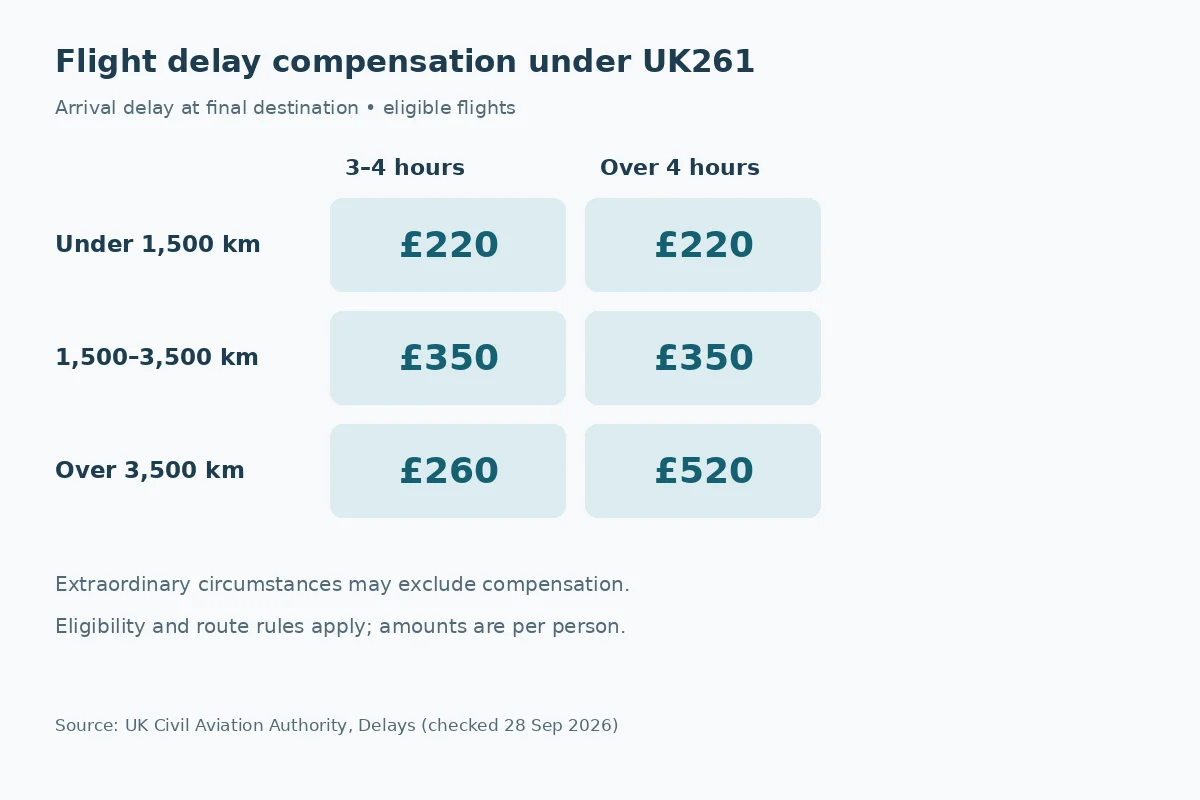
Under UK261 (the UK's retained version of the EU's air passenger rights rules), the UK Civil Aviation Authority sets fixed compensation amounts by flight distance for a flight arriving more than three hours late:
- £220 per person for flights under 1,500km.
- £350 per person for flights between 1,500km and 3,500km — every route from the UK to Málaga exceeds 1,500km, so this is the band that applies regardless of which UK airport a flight departs from.
- £260 per person for flights over 3,500km arriving 3–4 hours late, rising to £520 per person if the delay is more than 4 hours.
These are fixed sums set out directly on the CAA's own site — not a percentage of the ticket price, and not dependent on what was actually paid for the flight.
What has to happen for it to apply
Two conditions both have to be true. First, the delay itself: compensation applies once the flight arrives at its destination more than three hours later than scheduled. Citizens Advice notes a related but separate right — if the delay reaches five hours, a passenger can choose not to travel at all and get a refund instead of compensation. For a cancelled flight rather than a delay, Citizens Advice sets out that compensation depends on how much notice was given and how much later a replacement flight gets you there; cancelling with less than 14 days' notice, with a replacement arriving two or more hours late, brings the cancellation into the same compensation territory as a straightforward delay.
Second, the cause: the CAA's guidance is clear that compensation isn't owed if the airline can show the delay was caused by "extraordinary circumstances" — genuinely outside its control, such as severe weather, air traffic control action, or a security incident. A technical fault with the aircraft itself is generally treated as within the airline's control and doesn't usually count as extraordinary; a widespread air traffic control strike or a volcanic ash cloud typically would.
How to claim
The claim goes to the airline first, not the CAA directly. If the airline's final response is unsatisfactory, or it takes longer than eight weeks to respond, the CAA's guidance points to an Alternative Dispute Resolution (ADR) provider if the airline is signed up to one, or the CAA's own Passenger Advice and Complaints Team if it isn't. None of this requires a claims-management company or a paid intermediary — the process is designed to be handled directly by the passenger.
For the ground journey once you land, see this site's Marbella & Puerto Banús guide, and for what UK health cover does and doesn't travel with you, see Where to Find Help.
Questions people ask
How much compensation am I owed for a delayed flight to Málaga?
Under UK261, a flight under 1,500km delayed more than three hours qualifies for £220 per person. A flight of 1,500–3,500km qualifies for £350. A flight over 3,500km qualifies for £260 if it arrives 3–4 hours late, or £520 if it arrives more than 4 hours late — figures confirmed on the UK Civil Aviation Authority's own site.
What counts as an extraordinary circumstance the airline doesn't have to pay for?
Extraordinary circumstances are causes outside the airline's control, such as severe weather, air traffic control restrictions, or security risks — the CAA's guidance on entitlement explains the airline must be able to show the delay wasn't something it could reasonably have avoided.